
By Harpreet Ahuja
Guilty until proven innocent behind bars
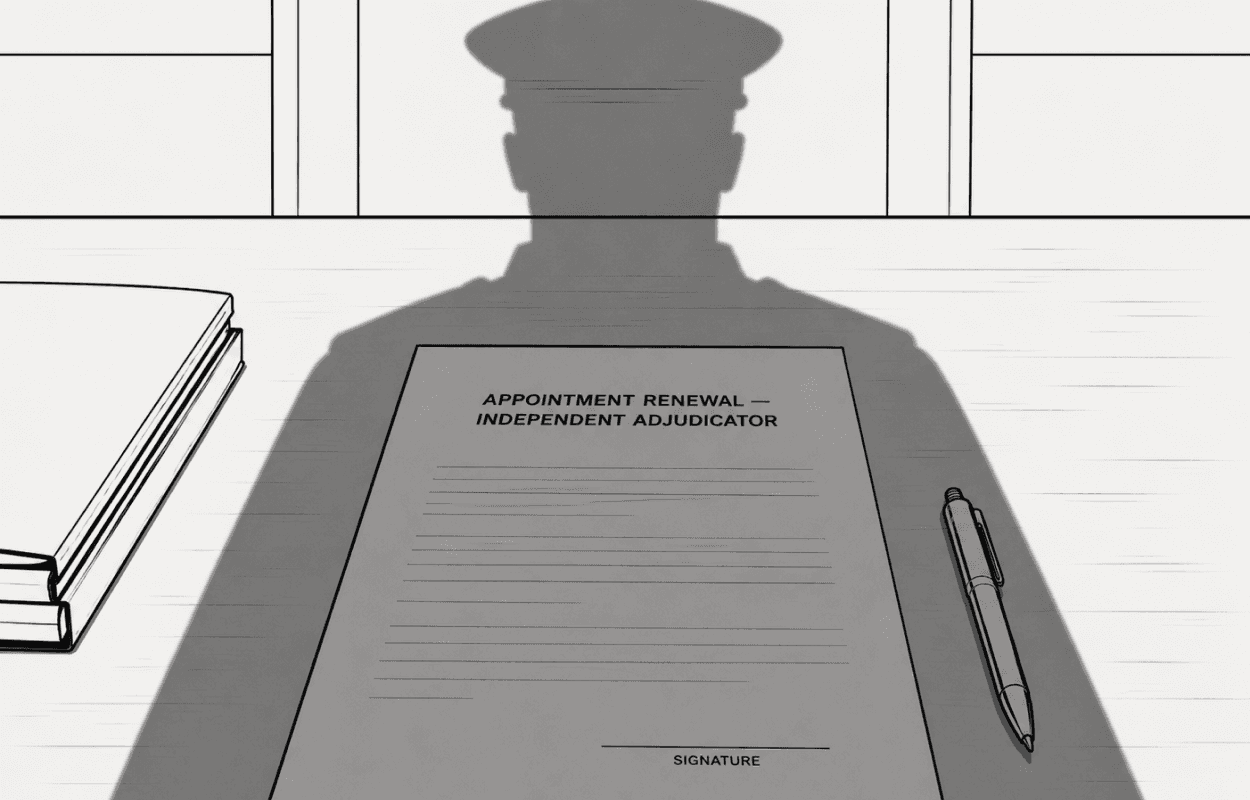
As one of the first four external decision-makers appointed to preside over disciplinary hearings in provincial facilities in British Columbia, my job was to replace assistant deputy wardens and bring independence to the process—or, as author Nelson M. Tsui describes it, to act as a “Prison Judge.” Yet despite the institutional promise of the Trotchie settlement, that independence failed in practice.
Achieving procedural fairness is undermined when the decider, the accuser, and the accused all operate under the same umbrella—especially when the institution can routinely bypass the disciplinary process using administrative segregation.
BC Corrections controls reappointment and oversight
Beyond the ethical weight of making the right call, I faced mounting day-to-day pressure from correctional facilities. In my role, I reported directly to senior management at BC Corrections.
Making a decision against a correctional centre triggered internal complaints
When I acquitted an inmate or imposed a lighter penalty, it triggered informal complaints. Senior leadership reviewed my hearing recordings and voiced their concerns in weekly meetings I attended. While never officially warned, I was made acutely aware of the prison staff’s frustration and faced animosity during subsequent hearings.
It soon became clear that the staff’s claims that my decisions were unfair were rooted in a fundamental disconnect: most officers had little to no legal training and struggled to understand why procedural fairness and the rule of law had to supersede facility preferences.
I didn’t anticipate how much time I’d spend bridging this gap: explaining to the officers in the room why I decided the way I did.
Hearing coordinators “protect their own”
During hearings, Disciplinary Hearing Coordinators (DHCs) managed logistics and represented the correctional facility. Outside the hearing room, however, these same DHCs served as Correctional Supervisors managing the very officers bringing allegations before me.
Throughout the process, I had to rely on DHCs—who lacked legal training—for full evidence disclosure, to clarify the legal elements of alleged Correction Act Regulation (CAR) breaches, and to explain centre policy and procedure. In an environment that prioritized staff morale over due process, driven largely by high officer turnover, expecting these supervisors to act as neutral officers created an unavoidable conflict of interest.
Conflict of interest among hearing coordinators
Having Correctional Supervisors act as DHCs compromised the hearing process. From where I sat, this dual role created four distinct conflicts of interest:
Driven by institutional pressure to “get the job done,” DHCs often prioritized speed over thoroughness to clear cases quickly and prevent administrative backlogs.
When testimony conflicted, DHCs favoured officer statements over prisoner testimony, operating on the presumption that staff were inherently truthful and prisoners were inherently suspect.
DHCs frequently brought outside knowledge into the hearing—such as a prisoner’s prior incarceration history, personal impressions of their “attitude,” or notes from institutional client logs. This reliance on outside evidence compromised their ability to present the case impartially.
DHCs were often aware of a prisoner’s pending criminal charges, directly undermining the presumption of innocence and the requirement that every breach allegation be assessed strictly on its own merits.

The access-to-justice crisis
Presiding over these hearings, I witnessed an overwhelming access-to-justice deficit. The vast majority of individuals appearing before me were self-represented, unable to retain legal aid due to staff shortages or afford private counsel. While Prisoners’ Legal Services worked tirelessly as the only clinic offering free representation, they lacked the resources to meet the demand.
From 2021 to 2023, only 31 out of 892 prisoners—just 3%—had legal counsel
The statistics reflect this reality: from 2021 to 2023, only 31 out of 892 prisoners—just 3%—had legal representation by their side, leaving the vast majority to navigate a complex legal process alone.
The administration segregation loophole
Even when I decided against imposing segregation or reduced a sanction, facilities routinely bypassed my decisions using administrative segregation. Under CAR 24(1), administrators could isolate prisoners for 22 hours or more a day without meaningful human contact, leaving them with barely enough time out of their cells for showers, exercise, or call a lawyer for summary advice. In practice, this regulatory loophole circumvented my authority and aggravated existing barriers to justice.
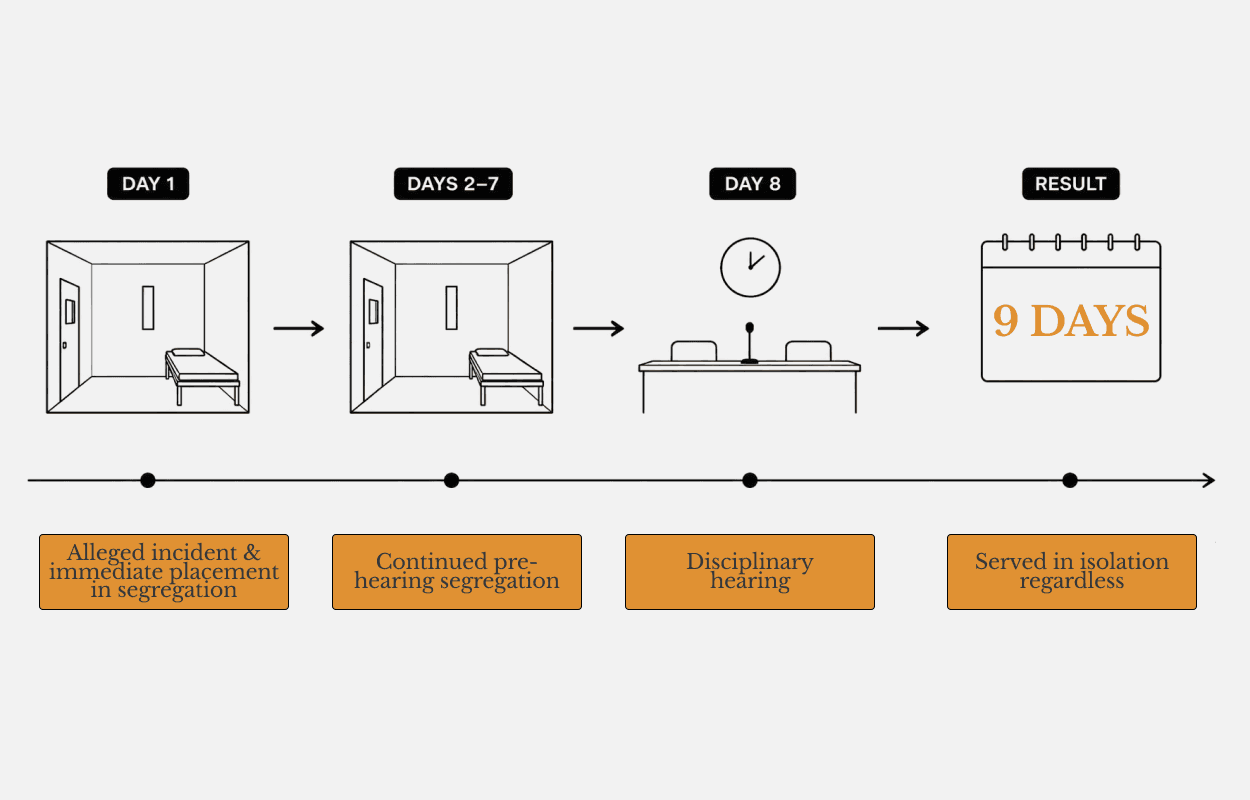
Under this provision, administrators held broad discretionary power to impose and renew segregation before a case ever reached my hearing room. They needed only “reasonable grounds” to show that a prisoner might endanger someone, jeopardize security, or impede evidence preservation—a far lower bar than the more onerous “beyond a reasonable doubt” standard. Administrators used this power to isolate individuals before I had the chance to look at the evidence.
Pre-hearing confinement as punishment
The CAR provides no legal authority to isolate a prisoner based solely on a pending charge. Yet, time and again, individuals arrived in my hearing room having already spent days in administrative segregation based on nothing more than informal accounts from charging officers. Often, this occurred without anyone reviewing video footage or investigating whether the individual had acted in self-defence.
Administrative segregation becomes the penalty, served before any finding of guilt
While I had the authority under CAR 27(1)(d) to credit pre-hearing segregation toward a penalty, that offered little comfort. When I found a prisoner not guilty or determined that segregation was unwarranted, the damage was already done. They had served time in isolation they could never get back, making administrative segregation the punishment—served before any finding of guilt.
The path forward
To resolve these inherent conflicts, advance prisoner rights, and restore integrity to BC’s disciplinary proceedings, three systemic reforms are urgently needed:
Prison Judges must belong to a separate branch of government—or, at a minimum, report outside of BC Corrections senior leadership—to render decisions free from institutional pressure.
DHCs must be independent, operate at arm’s length from BC Corrections, possess a legal background, and undergo mandatory training in procedural fairness. Independent DHCs would verify that sufficient evidence exists for a breach, oversee proper presentation of facts, and question witnesses, allowing the Prison Judge to remain strictly a neutral decision-maker.
Decisions to impose or renew CAR 24(1) administrative segregation must require approval from an independent adjudicator to ensure compliance with the law. While immediate segregation may be justified following a violent incident or security threat, maintaining CAR 24(1) confinement beyond 24 hours until a hearing takes place is an arbitrary practice. An external reviewer would enforce strict factual standards, ensuring isolation is imposed as a last resort, given its well-documented psychological harm to prisoners.
Explore the Terms: To better understand the institutional terms used in this post, you can explore my Beyond the Bars Prison Glossary.
Support the Cause: Support the rights and dignity of incarcerated individuals by purchasing a tote bag from My Store, where all proceeds go directly to Prisoners’ Legal Services.
Meet Harpreet: Harpreet Ahuja is a lawyer, human rights consultant, and social justice advocate driven by the conviction that systems need reimagining. Her work explores the intersection of law, policy, and lived experience—and tells the human stories behind injustice. Harpreet is based in Vancouver on the traditional, ancestral and unceded territories of the xʷməθkʷəy̓əm (Musqueam), Sḵwx̱wú7mesh (Squamish), and səlilwətaɬ (Tsleil-Waututh) Nations, and publishes on her website.


