By Harpreet Ahuja
The broken logic of prison discipline
Imagine being a prisoner and getting charged for yelling because you were starving and watched an officer throw out the last slice of bread; charged for non-compliance because you were sensitive to light, and partially covered your window with a paper towel; or charged for threatening behaviour because you refused to take two steps back while walking up a staircase.
These are some of the cases I presided over within the disciplinary system of BC jails.
Prison culture dictates reality
In this system, frustration with an unnatural environment and responses to unmet needs were treated as an intentional breach of security. Under the guise of protocol, the system masked its need for control while actively dehumanizing the people inside it. When an institution offers individuals no autonomy over their food, time, sleep, personal space, and safety, conflict is inevitable.
Turning predictable human friction into rule violations meant my days and weeks were filled with intense tension. More often than not, I found myself mediating between prisoners and prison staff, trying to encourage a “put yourself in their shoes” approach. It was hard when yelling escalated to profanity and behaviour was perceived as uncalled for. After all, guards were doing very demanding work in a similarly difficult environment; their reactions didn’t come out of nowhere.

Yet, while I tried to create a bridge of understanding, my approach failed—not for a lack of effort, but because no law, policy, or mandate was going to change how things actually worked on the ground. Beneath the surface, prison culture dictated reality. The conflict between written and unwritten rules was playing out, and working within the unwritten was where change was possible—not by ticking boxes on a legislative checklist.
“I told him to apologize”
Informal resolution was one such box. Under the Correction Act Regulation (CAR), staff were required to attempt it, but legal obligation rarely translated into meaningful effort. Instead, “just enough” was done to justify moving on to a charge. This often sounded like “I gave him two cooling-off opportunities, and the behaviour persisted,” even if those cooling-off opportunities took place within minutes of each other. Or, “I gave him an opportunity to apologize, and he refused.” The opportunity to apologize, however, was a demand, asserting dominance rather than encouraging repair.
Procedural box-checking became the default script in my hearing room:
I would ask an officer, “Did you exercise informal resolution under CAR 22(1)?”
“Yes, I told him to apologize and he didn’t.”
“Okay. CAR 22(1) was exercised but frustrated; let’s move into an evidentiary hearing.”
What awaited after that exchange was a prisoner who either refused to show up, was completely checked out, or reacted with anger—sometimes to the point of being escorted out midway.
“I got really angry. Wouldn't you?”
At other times, when I insisted that a prisoner share their side of the story, the human reality broke through the administrative jargon:
“I swear, I did not threaten him. Before the argument even took place, I asked for bread. I had no money left in my canteen account and I was starving. I asked the guard for a slice of bread and was told there wasn’t any for me to have. Then, a moment later, I saw him throw it out. I got really angry. Wouldn’t you?”

“I never got my medication. The nurse goes through her rounds quickly, so it’s hard to catch her. I’m irritable and more sensitive to light than usual, so I covered my window partially with a paper towel. The guard could still see through it for his security check. When he told me to remove it, even though I explained to him what I was going through, I yelled and even cursed at him, but I did not threaten him.”
“She raised her voice first. I do not understand what the issue is with walking past her on the staircase. She asked me to walk farther behind her. Yes, she asked me twice to lock up, and I refused because I wanted to speak to a supervisor. I’ve never heard of such a thing. It’s degrading.”
As I listened to these testimonies, it was almost impossible not to see natural human responses to unmet needs. At the core of the breakdown was a drive to assert authority and demand compliance.
Staff often invoked the slippery slope argument: “If I let him cover his window, then all the inmates on the living unit will want to do the same.” Other times, past tragedy was used to justify the enforcement: “We’ve had deaths and escapes here. Conducting a proper security check is our duty.”
“Punishing harder” doesn’t work
The institution could rationally justify its position using policy and procedure, resulting in a finding of guilt. The impact on the prisoner was an internal record of misconduct that hindered their ability to apply for better conditions of confinement or early release—and, if on remand, could prejudice their criminal trial. Rarely would an officer dig deeper into the hearing decision to learn that the misconduct involved hunger, sleep deprivation, or an arbitrary practice, rather than a violation of clear written rules.
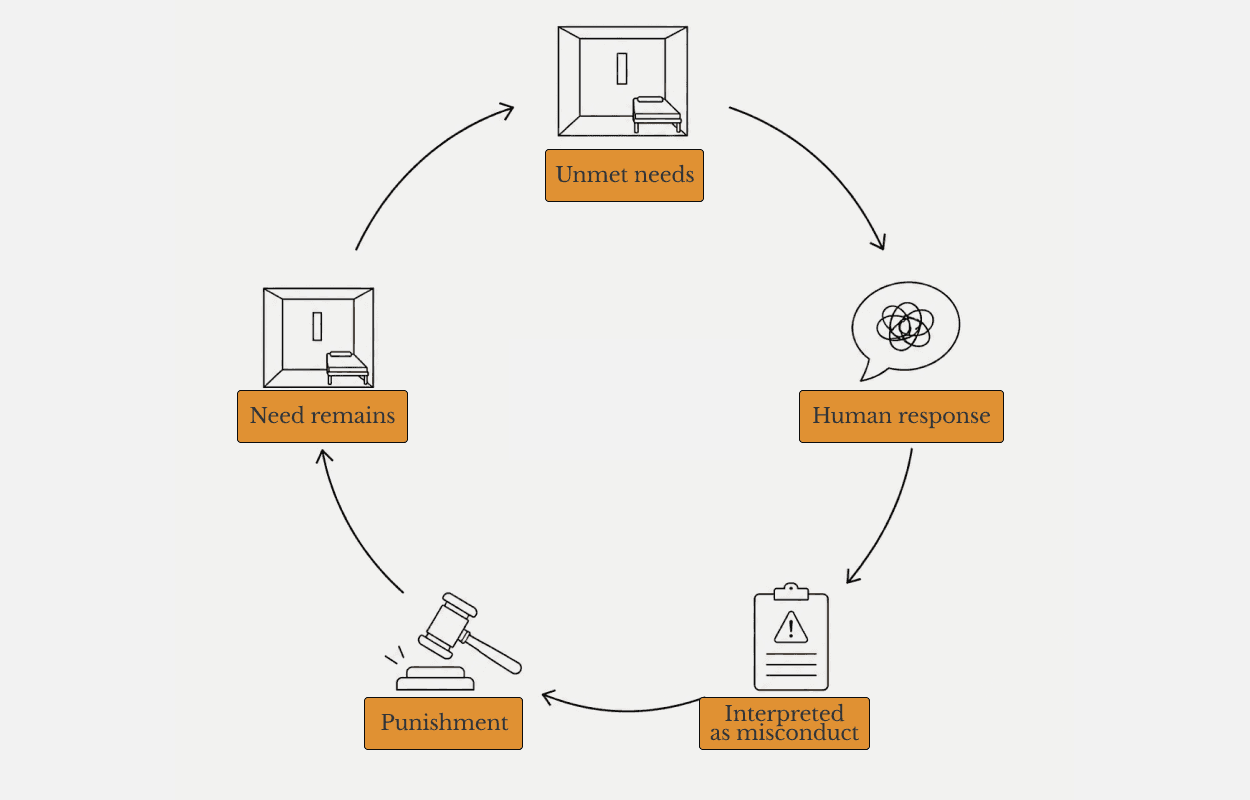
If a prisoner appeared before me again and was found guilty of breaking a similar rule, established practice mandated the use of progressive discipline. This meant penalties escalated with each infraction—for example, moving from a warning or extra duties (such as a written apology) to restricted time on the range. But this did nothing to de-escalate tension or prevent the same reaction, starting the cycle all over again.
When people are treated as lesser beings and deprived of basic needs, the outcome will always be pushback against those oppressive forces. There is a fallacy that punishing someone, and punishing them harder if they repeat an infraction, prevents the behaviour from happening. It fails because fundamental human needs cannot be punished away.
What is required to break the revolving door of the disciplinary system is to stop punishing the natural human responses to an inhumane environment and start addressing the basic unmet needs that drive them.
Author’s Note: The cases are drawn from my experience as an external independent decision-maker presiding over disciplinary hearings for BC Corrections (2021–2023).
Explore the Terms: To better understand the institutional terms used in this post, you can explore my Beyond the Bars Prison Glossary.
Support the Cause: Support the rights and dignity of incarcerated individuals by purchasing a tote bag from My Store, where all proceeds go directly to Prisoners’ Legal Services.
Meet Harpreet: Harpreet Ahuja is a lawyer, human rights consultant, and social justice advocate driven by the conviction that systems need reimagining. Her work explores the intersection of law, policy, and lived experience—and tells the human stories behind injustice. Harpreet is based in Vancouver on the traditional, ancestral and unceded territories of the xʷməθkʷəy̓əm (Musqueam), Sḵwx̱wú7mesh (Squamish), and səlilwətaɬ (Tsleil-Waututh) Nations, and publishes on her website.