By Harpreet Ahuja
Author’s Note: Writing this post involves a risk I acknowledge and fear. I am apprehensive about straining or severing ties with the people I care about who may read this and struggle to fully grasp, or perhaps even reject, my reality. My intention is not to wound, accuse, or divide, but recount an ongoing experience that needs to be told. This is not written to create distance, but in the hope that honesty can foster connection, rather than widen it.
Names have been changed to protect privacy.
We need to address the gap between how racism is imagined and how it is lived
I am a brown, interracial woman from a poor socioeconomic background. My partner and his family are white educated upper-middle class and identify as progressive liberals. This clash of positionality was crystallized during my first encounter with his aunt and uncle, Julie and Tom. Almost six years after the pandemic, they maintain a strict, non-negotiable set of rules (which they call “precautions”) for all indoor interactions. Neither Julie nor Tom is immunocompromised. They insist that one of the reasons these rules are imposed is to protect “minorities” and Indigenous communities who, they assert, are disproportionately impacted by the coronavirus.
If I choose to spend time with them indoors, I must adhere to these exacting rules (which become more so during Canadian winters): I must get tested for COVID and send them a photo of my negative results before we meet, or, as an alternative, they have a very expensive machine and can test me on the spot; I must wear a mask in all indoor spaces I enter (this means I cannot eat indoors in restaurants even on the day of our visit), and when I am around them, I cannot interact with anyone indoors—including visits with my own family and friends—without a mask on at all times, unless that person has gone through their vetting process.
Being told what I must do to attend family gatherings where they are present left me with an uneasy feeling. Unlike the experience of overt racism, which becomes quite clear almost immediately, it took me a few days to process this experience.
Racism among white educated progressive liberals is so sophisticated that it’s very difficult to call out
My unease came from someone wanting to do something “good” for “us” without fostering meaningful relationships or engaging in consultation and consent with the communities they claimed to protect. I was one of the people they said they were performing this selfless and righteous act for. Yet, I wasn’t asked what I needed or if I even wanted to abide by their rules. Instead, I was told that their rules were in my best interest and that of “people like me.” If I do not adhere to their rules, I cannot attend family gatherings.
I am the first—and so far only— person to push back against this imposition by highlighting the harmful and problematic nature of their white saviourism.
Drawing on the work of Layla F. Saad, it seems benign on the surface: trying “to help” the marginalized, trying to give voice to the “voiceless,” trying to advocate for people who “cannot advocate for themselves.” In reality, like colonialism, white saviourism assumes that Black, Indigenous, and People of Colour (BIPOC) need white people to save them. This puts BIPOC in the position of helpless children who need to be saved by the supposedly more capable and wiser white people. White saviourism is condescending and paternalistic and reinforces white supremacist characteristics like objectivity (for more, see: White Supremacy Culture—Still Here).
Ultimately, they found being confronted about racism more offensive than their racist behaviour
I did not grasp the seriousness of the consequences when I pointed out their white saviourism. They pride themselves on progressive liberal ideals: they donate to charities, are avid readers on climate change and make conscious choices in their daily lives to minimize their footprint, and boldly announce their beliefs in an effort to get others on board. So when I confronted them openly about their racism, assuming their commitment to self-awareness was genuine, I expected curiosity and a willingness to engage in dialogue. Instead, I met a wall. I was profoundly wrong.
The deception with white liberal progressives is that they believe they are inherently “good” and in the service of good. This makes the possibility that they could cause harm through racist behaviour deeply triggering, because it shatters the core of their identity.
When I shared with them that their approach is harmful, they immediately offered to send me academic research on the prevalence of COVID. I understood then that because they had not engaged in community consultation—including meaningful reciprocal dialogue with me, a person they claim to be doing this for—peer-reviewed research holds greater value for them than lived experience, as it represents “objective,” “legitimate” knowledge.
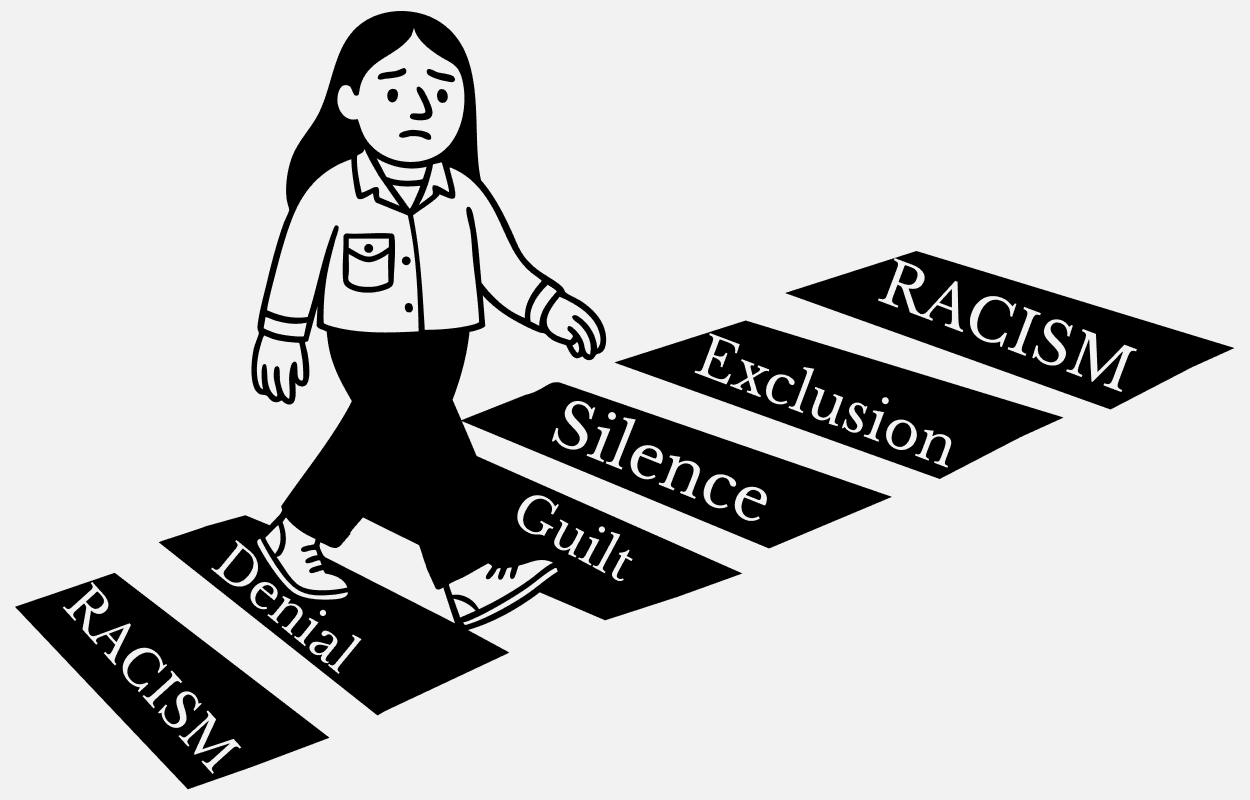
Denying my experience of racism acts like a “get out of jail free card,” allowing Julie and Tom to avoid accountability. The dual harm of this denial is that it also rejects the need for change—personal and systemic—thereby keeping racism intact.
Instead of perpetuating white saviourism, we can begin our journey of dismantling it by asking ourselves:
Have you spoken over or corrected a Black, Indigenous, or Person of Colour (BIPOC), such as by insisting your view is the best solution, because you felt you knew better or could explain their experiences to them or on their behalf?
Do you see yourself as a progressive liberal or activist whose position is to do good by giving voice to those who are “voiceless”? (There is no such thing as the voiceless; there are only those who are deliberately unheard.)
Have you felt “attacked” or portrayed yourself as a victim (for example, by stating that you feel psychologically unsafe or unappreciated) when a BIPOC brings to your attention that they don’t need your “help,” but need you to ask them about their needs, actively listen, do the work to partner alongside them, consult with them, and ask for consent before acting or speaking on their behalf?
If you’ve answered yes to any or all of the above, ask yourself “Why?”.
When confronted with their white saviourism, Julie and Tom denied my experience and refused to participate in a discussion, which over time manifested as avoidance. This dynamic became especially problematic when they dismissed the validity of a direct lived account by countering with what they believed to be a “superior” source of knowledge.
True progressive action begins with the commitment to being open to re-evaluating one’s beliefs or behaviour. Meaningful and sustainable change requires moving past the desire for a “feel good” easy fix or a universally applicable answer. It demands constant self-questioning, humility, and specific consultation with the local community or individual involved in a given context, placing direct human experience above any single article or general principle.
Only then can we move beyond the perpetual cycle of racism and toward genuine solidarity.
P.S. Don’t forget! We can all be racists. While this reality for many is jarring, it is an inevitable result of living in a culture of white supremacy. No one is immune. It doesn’t matter what your skin colour is or your background, we all carry deeply ingrained views about ourselves shaped by our relationship (or lack thereof) with “the other.”
Meet Harpreet: Harpreet Ahuja is a lawyer, human rights consultant, and social justice advocate driven by the conviction that systems need reimagining. Her work explores the intersection of law, policy, and lived experience—and tells the human stories behind injustice. Harpreet is based in Vancouver on the traditional, ancestral and unceded territories of the xʷməθkʷəy̓əm (Musqueam), Sḵwx̱wú7mesh (Squamish), and səlilwətaɬ (Tsleil-Waututh) Nations, and publishes on her website.


